AB NA x (0.5 + rbp-Negative)
AB PA = Affective Balance of positive affect.
AB NA = Affective Balance of negative affect.
rbp-Positive = Effect size differences between positive affect groups (lower vs. higher).
rbp-Negative = Effect size differences between negative affect groups (lower vs. higher).
Table 1
Affective Balance (AB) equivalences (degrees) after correction for effect sizes of 0.1,0.3 and 0.5. Applicable in the calculation of ABPA and ABNA
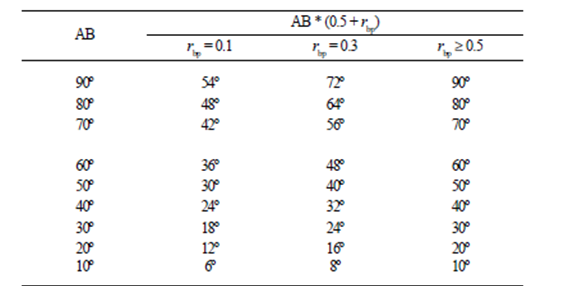
Note. AB correction was applied when rbp < 0.5.
2.7. Decision criteria:
2.7.1. Negative Partial imbalance (NPI). The criterion to determine a negative partial imbalance (only occurs in negative affect) is established from an AB above + 45º in negative affect. This value implies that more than half of the students score in negative affect with medium-high values.
2.7.2. Positive Partial Imbalance (PPI). The criterion to determine a partial positive imbalance (only occurs in positive affect) is established from an AB below - 45º in positive affect. This value implies that more than half of the students score in positive affect with medium-low values.
2.7.3. Total Imbalance (TI). The criterion to determine a total imbalance (it occurs in both positive and negative affect) is established based on an AB in negative affect above +45º and an AB in positive affect below -45º. This value implies that more than half of the students score in negative affect with medium-high values, and more than half of the students score in positive affect with medium-low values.
Data analysis
Descriptive analyses were conducted to characterize the distribution of all study variables across groups, including measures of central tendency and dispersion. Second, the affective balance of each of the groups was calculated, using the procedure described in the previous section, which integrates both affective quantity and magnitude. Comparative analyses were then performed to examine potential differences in affective balance between groups. Finally, the relationship between affect (positive and negative) and the levels of emotional dysregulation was analyzed in each group using Spearman’s rank- order correlation, due to the non-normal distribution of some variables. The datasets generated and analyzed during the current study are available in the Dataverse repository: https://osf.io/r6ey7/?view_only=dbdd42226db7455fad64deb64e69047a
Results
Descriptive analysis
Descriptive statistics for all variables in each group are presented in Table 2. No statistically significant differences were found between group 1 (G1) and group 2 (G2) in the levels of positive (z = -.46, p = .647) and negative affect (z = -1.15, p = .249).
Table 2
Descriptive measures of affect (PANAS) and emotional dysregulation (DERS) in group 1 (N = 30) and 2 (N = 25)
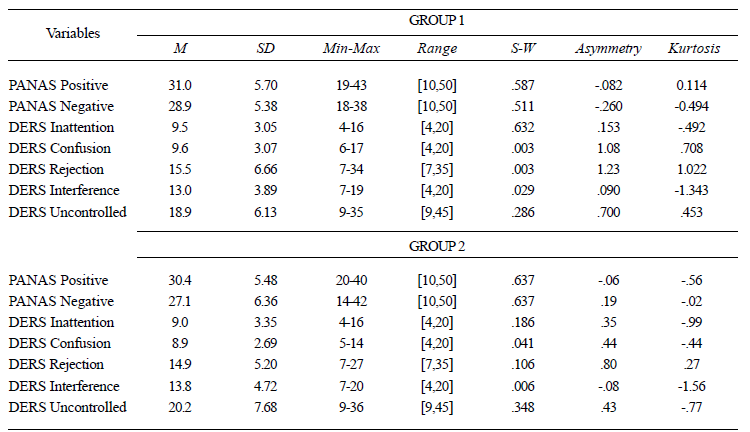
Note. Emotion Regulation Questionnaire (ERQ); Difficulties in Emotion Regulation Scale (DERS); Shapiro-Wilks (S-W); Positive (P) and negative (N) affect questionnaire (PANAS).
Affective balance results for Group 1 and Group 2
• Group 1: The analysis of frequencies for negative affect shows no participants at the midpoint of the PANAS scale (0.00%), with 17 participants scoring below (56.67%) and 13 scoring above this value (43.33%). In contrast, the analysis of frequencies for positive affect reveals 1 subject in the middle range (3.33%), 10 below it (33.33%), and 19 above it (63.33%). The effect size calculated for the differences between the participants scoring above and below 30 for negative affect was rbp = .83, while for positive affect, it was rbp = .80. Based on these results, the calculation of the affective balance does not indicate the presence of affective imbalance (Table 3-Left: -12.00º / +27.00º). Since the effect size exceeds 0.5 (indicating a large effect size), no adjustment to the AB is necessary (refer to Table 1 for equivalences).
• Group 2: The analysis of frequencies for negative affect shows no participants at the midpoint of the PANAS scale (0.00%), with 17 participants scoring below (68.00%) and 8 scoring above (32.00%). For positive affect, the analysis shows 2 participants in the middle range (8.00%), 10 below it (40.00%), and 13 above it (52.00%). The effect size was rbp = .82 for negative affect and rbp = .84 for positive affect. Consequently, the calculation of the affective balance does not reveal any affective imbalances (Table 3-Right: -32.40º / +10.80º). As in Group 1, since the effect size is greater than 0.5 (indicating a large effect), no correction to the AB is required (refer to Table 1 for equivalences).
Correlations within each group between affect (positive and negative) and the dimensions of emotional dysregulation (DERS) showed a stronger association between negative affect and emotional dysregulation in Group 1 than in Group 2. However, no statistically significant differences were found between Group 1 and Group 2 in the dimensions of emotional dysregulation (Table 4).
Table 3
Analysis of the affective balance of group 1 and 2
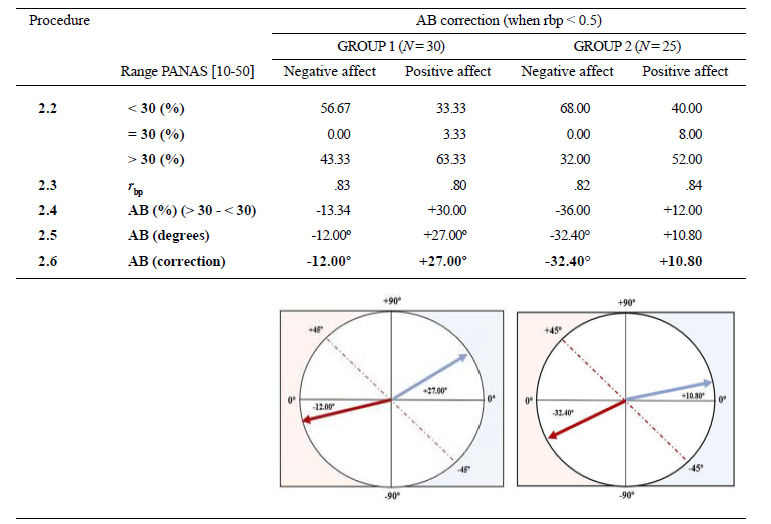
Note. Affective Balance (AB), affect questionnaire (PANAS).
Table 4
Group correlation analysis between affect levels (PANAS: positive and negative) and dysregulation scales (DERS)
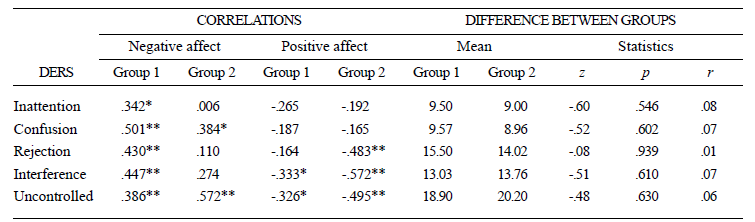
Note. *p < .05, ** p < .01.
Discussion
This research examined affective balance in two groups of university students and its association with emotional dysregulation. Although differences in affective balance were observed between the groups, neither group met the criteria for affective imbalance (see Table 3). Correlation analyses between positive and negative affect and the dimensions of emotional dysregulation revealed distinct patterns depending on the student group. In Group 1, a stronger relationship was observed between negative affect and all dimensions of emotional dysregulation. This suggests that emotional dysregulation may be associated with a moderating variable influencing affective balance in this group. These findings are consistent with recent research indicating that emotional dysregulation is associated with the development of negative affect and psychosomatic symptoms among university students (Teixeira et al., 2022). The authors emphasize the importance of implementing developmental programs focused on emotion regulation to support students effectively. Therefore, while neither group exhibited affective imbalance, Group 1 showed higher levels of negative affect than Group 2. Additionally, it is important to consider that the measure of affect was taken one month after the start of classes, suggesting that affective balance may vary over time throughout the academic year, potentially leading to increased levels of imbalance. Based on these findings, educators may consider intervening proactively to mitigate potential issues by assessing affect at various points throughout the academic year and implementing strategies to reduce negative affect and enhance positive affect if the criteria for affective imbalance are met.
The integration of emotion regulation into academic curricula has gained significant relevance in recent years (Chatterjee & Duraiappah, 2020). A range of tools now exists to enhance emotion regulation skills in both teachers and students (Hoffmann et al., 2020). In particular, social and emotional learning (SEL) programs implemented in school settings facilitate the development of social and emotional intelligence, enabling individuals to understand and manage their emotions, establish and maintain positive relationships, make responsible decisions, and adopt adaptive behaviors. Promoting these skills has been linked to increased academic engagement, improved behavior, stronger attachment to school, protection for at-risk youth, and enhanced academic performance (Green et al., 2021). Furthermore, SEL programs have demonstrated significant benefits within higher education contexts (e.g., Elmi, 2020). Emotion regulation skills develop throughout adolescence, marked by significant changes, including academic pressures and evolving personal relationships, heightening the demands of adapting to one’s environment. Effective emotion regulation in academic settings has been associated with students’ learning, participation, and overall academic performance (Jacobs & Gross, 2014). Additionally, research indicates that difficulties in emotion regulation can adversely affect the psychological well-being of college students (Khalil et al., 2020).
Emotion regulation may play a crucial role in modulating the affective levels within student groups. Therefore, using affective balance to monitor these groups may provide a useful framework for analyzing emotional dynamics in the classroom. This approach could be compatible with personalized interventions and may also be beneficial in addressing individual students while considering their interactions within the group, thereby potentially enhancing the effectiveness of educational interventions. Moreover, continuous analysis of affective balance could be implemented throughout the academic development of student groups, allowing for systematic monitoring of their emotional evolution and offering insights into the group’s overall affective trends. The proposed analyses could also be conducted using various questionnaires beyond those employed in this research. Notably, many educational interventions often lack a systematic analytical methodology, relying heavily on the subjective judgment of educators. The analytical methods introduced in this research may represent an advancement toward establishing clear criteria to help identify the psychological variables influencing the development and evolution of affect in the classroom. This is important because, to date, few procedures provide a comprehensive measurement of the affective balance in student groups—one that integrates both the quantity and intensity of emotions. The procedure presented in this article may allow the analysis of how a group’s emotional state evolves during the academic year. It assesses the percentage of students whose emotions are above or below the mean (affective quantity) and the intensity of their emotional expressions (affective magnitude). This method aligns with current educational trends that emphasize the development of socioemotional intelligence and advocate for a holistic approach to student growth, integrating both cognitive and emotional aspects of learning (Devis-Rozental & Farquharson, 2020). A reliable procedure for measuring the group’s affective state could help educators evaluate the effectiveness of teaching strategies designed to foster an integrated emotional and cognitive learning experience at various points throughout the year.
Additionally, it is important to consider more precise measures of affect that is spatially and temporally limited. In this research, participants completed the questionnaires online. For future studies aimed at validating this procedure, it would be beneficial to include measures of affect that specifically account for the educational context, thereby minimizing the influence of other interaction contexts that may affect students’ emotional levels. To this end, PANAS is recommended, instructing students to respond to the items with reference to the educational context, specifically classroom affect. Furthermore, administering the questionnaire in the classroom can enhance students’ affective awareness when evaluating their emotional state. Other factors that may influence levels of affect should also be taken into account, such as the type of studies, schedules, and class attendance. Additionally, this approach could also be applied in other contexts, such as healthcare, where issues like anxiety and depression can significantly impact the performance and mental health of healthcare workers. This was particularly evident during the COVID-19 pandemic (Sun et al., 2021), highlighting that, beyond specific emergencies, affective imbalances can have detrimental consequences for the mental health of these professionals, which in turn affects patient care.
No affective imbalances were detected among the student groups analyzed in the present investigation. Should such imbalances be identified in future research, it may be advisable to implement social and emotional learning (SEL) programs, which have demonstrated effectiveness in various studies (Elmi, 2020; Green et al., 2021; Hoffmann et al., 2020). Additionally, it is important to identify contextual variables that may influence negative affect, aiming to mitigate or eliminate these factors. For instance, research by Llinares et al. (2021) has shown that cool-toned colours on classroom walls can enhance arousal, attention, and memory. Additionally, coloured lighting in the classroom has been found to positively impact both cognitive and emotional processes (Quiles-Rodríguez & Palau, 2024). More broadly, factors such as lighting, temperature, air quality, and colour have all been associated with students’ academic performance (Barrett et al., 2015). In this study, the different schedules of the student groups analyzed could be interpreted as a potential modulating variable affecting affective balance.
The findings of this study should be interpreted with caution due to several limitations: First, the proposed procedure for assessing affective balance should be considered exploratory, as further research is needed to examine its psychometric properties, including its reliability, sensitivity, and predictive validity. Second, affect was measured at a single time point and through self-report instruments, which may be influenced by contextual or subjective factors. Third, the relatively small sample size may limit the generalizability of the results and reduce the statistical power of the analyses, and the cross-sectional design does not allow causal relationships to be established between affective balance and emotional dysregulation. Future research should prioritize longitudinal studies that assess affect at multiple time points to explore its relationship with intervention strategies and academic performance.
In conclusion, this proposal for analyzing affect in the educational context may offer several potential benefits: 1) It may facilitate a rapid, clear, and updated assessment of student affect; 2) It may help to frame affect in terms of affective balance, aiding interpretation through established thresholds that inform teachers about the necessity for psychoeducational interventions; 3) It could enable ongoing monitoring of students’ affective states throughout the academic year; and 4) It may provide insights into the group’s overall affective balance.
Conflict of interest
The authors declare no conflict of interest.
Ethical responsibility
All procedures involving human participants were conducted in accordance with the ethical standards set forth by the institutional and/or national research committee, as well as the 1964 Helsinki Declaration and its subsequent amendments. The study received approval from the Research Ethics Committee of the University of Salamanca (code 1281).
Authorship contributions
FGL: Conceptualized and proposed the research problem, participated in the review, selection, analysis, and interpretation of the results, as well as in the revision and drafting of the manuscript.
AJO: Participated in the review of the literature, selection of materials, and contributed to the drafting and critical revision of the manuscript.
AVC: Contributed to the selection and preliminary analysis of materials, as well as to the drafting of specific sections of the manuscript.
LMH: Participated in the review of the literature and provided input for the interpretation of the results.
GGG: Assisted in the organization of materials and contributed to the review of the manuscript.
References
Alonso-Tapia, J., & Nieto, C. (2019). Classroom emotional climate: Nature, measurement, effects and implications for education. Revista de Psicodidáctica, 24(2), 79-87. https://doi.org/10.1016/j.psicod.2018.08.002
Aristizábal, Y. M., Jiménez, Á. A., & Ortega, J. M. (2025). Students’ emotions toward assessments: A systematic review. Social Sciences, 14(11), 652. https://doi.org/10.3390/socsci14110652
Augustine, A. A., & Larsen, R. J. (2015). Personality, affect, and affect regulation. In M. Mikulincer, P. R. Shaver, M. L. Cooper, & R. J. Larsen (Eds.), APA handbook of personality and social psychology (Vol. 4, Personality processes and individual differences, pp. 147-165). American Psychological Association. https://doi.org/10.1037/14343-007
Barrett, P., Davies, F., Zhang, Y., & Barrett, L. (2015). The impact of classroom design on pupils’ learning: Final results of a holistic, multi-level analysis. Building and Environment, 89, 118-133. https://doi.org/10.1016/j.buildenv.2015.02.013
Bradburn, N. M. (1969). The structure of psychological well-being. Aldine.
Camacho-Morles, J., Slemp, G. R., Pekrun, R., Loderer, K., Hou, H., & Oades, L. G. (2021). Activity achievement emotions and academic performance: A meta-analysis. Educational. Psychology Review, 33(3), 1051-1095. https://doi.org/10.1007/s10648-020-09585-3
Canedo, C. M., Andrés, M. L., Canet-Juric, L., & Rubiales, J. (2019). Influencia de las estrategias cognitivas de regulación emocional en el bienestar subjetivo y psicológico en estudiantes universitarios. Liberabit, 25(1), 25-40.
Chatterjee, N., & Duraiappah, A. K. (2020). Rethinking learning: A review of social and emotional learning frameworks for education systems. UNESCO Mahatma Gandhi Institute of Education for Peace and Sustainable Development (MGIEP). https://unesdoc.unesco.org/ark:/48223/pf0000373890
Chen, Z., Wang, H., Wei, B., Xu, C., & Guo, Y. (2026). Associations between physical activity, depression and anxiety in adolescents: The mediating role of emotion regulation strategies and flexibility subgroups. BMC Psychology, 14, 26. https://doi.org/10.1186/s40359-025-03787-6
Chen-Bouck, L., Patterson, M. M., & Peng, A. (2024). Relations of coping strategies and cognitive emotion regulation to Chinese children’s academic achievement goals and academic performance. Frontiers in Psychology, 15, 1454886. https://doi.org/10.3389/fpsyg.2024.1454886
Cohen, J. (1988). Statistical power analysis for the behavioral sciences. Lawrence Erlbaum.
Devis-Rozental, C., & Farquharson, L. (2020). What influences students in their development of socio- emotional intelligence whilst at university? Higher Education Pedagogies, 5(1), 294-309. https://doi.org/10.1080/23752696.2020.1820887
Eaton, R. J., & Bradley, G. (2008). The role of gender and negative affectivity in stressor appraisal and coping selection. International Journal of Stress Management, 15(1), 94-115. https://doi.org/10.1037/1072-5245.15.1.94
Egan, L. A., Park, H. R. P., Lam, J., & Gatt, J. M. (2024). Resilience to stress and adversity: A narrative review of the role of positive affect. Psychology Research and Behavior Management, 17, 2011-2038. https://doi.org/10.2147/PRBM.S391403
Elmi, C. (2020). Integrating social emotional learning strategies in higher education. European Journal of Investigation in Health, Psychology and Education, 10(3), 848-858. https://doi.org/10.3390/ejihpe10030061
Flückiger, C., Mahlke, F., John, G., Daus, P., Zinbarg, R. E., Allemand, M., & Schürmann-Vengels, J. (2025). How strongly are trait positive and negative affectivity associated with anxiety symptoms? A multilevel meta- analysis of cross-sectional studies in anxiety disorders. Journal of Anxiety Disorders, 109, 102956. https://doi.org/10.1016/j.janxdis.2024.102956
Gendolla, G. H. E., Abele, A. E., & Krüsken, J. (2001). The informational impact of mood on effort mobilization: A study of cardiovascular and electrodermal responses. Emotion, 1(1), 12-24. https://doi.org/10.1037/1528-3542.1.1.12
Gratz, K. L., & Roemer, L. (2004). Multidimensional assessment of emotion regulation and dysregulation: Development, factor structure, and initial validation of the difficulties in emotion regulation scale. Journal of Psychopathology and Behavioral Assessment, 26(1), 41-
54. https://doi.org/10.1023/B:JOBA.0000007455.08539.94
Green, A. L., Ferrante, S., Boaz, T. L., Kutash, K., & Wheeldon-Reece, B. (2021). Social and emotional learning during early adolescence: Effectiveness of a classroom based SEL program for middle school students. Psychology in the Schools, 58(6), 1056-1069. https://doi.org/10.1002/pits.22487
Herrando, C., & Constantinides, E. (2021). Emotional contagion: A brief overview and future directions. Frontiers in Psychology, 12, 712606. https://doi.org/10.3389/fpsyg.2021.712606
Hervás, G., & Jódar, R. (2008). Adaptación al castellano de la Escala de Dificultades en la Regulación Emocional. Clínica y Salud, 19(2), 139-156
Hoffmann, J. D., Brackett, M. A., Bailey, C. S., & Willner, C. J. (2020). Teaching emotion regulation in schools: Translating research into practice with the RULER approach to social and emotional learning. Emotion, 20(1), 105-109. https://doi.org/10.1037/emo0000649
Jacobs, S. E., & Gross, J. J. (2014). Emotion regulation in education: Conceptual foundations, current applications, and future directions. In R. Pekrun, & L. Linnenbrink-Garcia (Eds.), International handbook of emotions in education (pp. 183-201). Routledge/Taylor & Francis Group.
Järvenoja, H., Näykki, P., & Törmänen, T. (2019). Emotional regulation in collaborative learning: When do higher education students activate group level regulation in the face of challenges? Studies in Higher Education, 44(10), 1747-1757. https://doi.org/10.1080/03075079.2019.1665318
Khalil, Y., del Valle, M. V., Zamora, E. V., & Urquijo, S. (2020). Dificultades de regulación emocional y bienestar psicológico en estudiantes universitarios. Revista Subjetividad y Procesos Cognitivos, 24(1), 69-83.
Liang, H., & Mao, X. (2025). Emotion regulation and perceptions of academic stress as key predictors of academic motivation in second language learning. PloS One, 20(8), e0327071. https://doi.org/10.1371/journal.pone.0327071
Llinares, C., Higuera-Trujillo, J. L., & Serra, J. (2021). Cold and warm coloured classrooms. Effects on students’ attention and memory measured through psychological and neurophysiological responses. Building and Environment, 196, 107726. https://doi.org/10.1016/j.buildenv.2021.107726
Lyubomirsky, S., King, L., & Diener, E. (2005). The benefits of frequent positive affect: Does happiness lead to success? Psychological Bulletin, 131(6), 803-855. https://doi.org/10.1037/0033-2909.131.6.803
Mayor-Silva, L. I., Meneses-Monroy, A., Rodriguez-Leal, L., & Moreno, G. (2024). An exploration of resilience and positive affect among undergraduate nursing students: A longitudinal observational study. Nursing Reports, 14(2), 871-882. https://doi.org/10.3390/nursrep14020067
Mendzheritskaya, J., & Hansen, M. (2019). The role of emotions in higher education teaching and learning processes. Studies in Higher Education, 44(10), 1709- 1711. https://doi.org/10.1080/03075079.2019.1665306
Neumann, R., & Strack, F. (2000). «Mood contagion»: The automatic transfer of mood between persons. Journal of Personality and Social Psychology, 79(2), 211-223. https://doi.org/10.1037/0022-3514.79.2.211
Öztekin, G. G., Gómez-Salgado, J., & Yildirim, M. (2025). Future anxiety, depression and stress among undergraduate students: psychological flexibility and emotion regulation as mediators. Frontiers in Psychology, 16, 1517441. https://doi.org/10.3389/fpsyg.2025.1517441
Papantoniou, G., Moraitou, D., Kaldrimidou, M., Plakitsi, K., Filippidou, D., & Katsadima, E. (2012). Affect and cognitive interference: An examination of their effect on self-regulated learning. Education Research International, 22(1), 579590. https://doi.org/10.1155/2012/579590
Parra-Gaete, C., & Hermosa-Bosano, C. (2023). A pilot exploration of the relationships between optimism, affect, and cardiovascular reactivity. Frontiers in Psychology, 14, 1233900. https://doi.org/10.3389/fpsyg.2023.1233900
Pekrun, R., & Linnenbrink-Garcia, L. (Eds.). (2014). International handbook of emotions in education. Routledge/Taylor & Francis Group.
Pekrun, R., Frenzel, A. C., Goetz, T., & Perry, R. P. (2007). The control-value theory of achievement emotions: An integrative approach to emotions in education. In P.
A. Schutz & R. Pekrun (Eds.), Emotion in Education (pp. 13-36). Academic Press. https://doi.org/10.1016/B978-012372545-5/50003-4
Pressman, S. D., Jenkins, B. N., & Moskowitz, J. T. (2019). Positive affect and health: What do we know and where next should we go? Annual Review of Psychology, 70, 627-650. https://doi.org/10.1146/annurev-psych-010418-102955
Prochazkova, E., & Kret, M. E. (2017). Connecting minds and sharing emotions through mimicry: A neurocognitive model of emotional contagion. Neuroscience & Biobehavioral Reviews, 80, 99-114. https://doi.org/10.1016/j.neubiorev.2017.05.013
Purnamaningsih, E. H. (2017). Personality and emotion regulation strategies. International Journal of Psychological Research, 10(1), 53-60. https://doi.org/10.21500/20112084.2040
Quiles-Rodríguez, J., & Palau, R. (2024). Effects of colored lighting on learning processes: Towards a smart classroom. Journal of Technology and Science Education, 14(2), 484-506. https://doi.org/10.3926/jotse.2236
Salazar, C., Aguilar, J., Monsalve-Pulido, J., & Montoya, E. (2021). Affective recommender systems in the educational field. A systematic literature review. Computer Science Review, 40, 100377. https://doi.org/10.1016/j.cosrev.2021.100377
Sánchez-García, M. A., Lucas-Molina, B., Fonseca-Pedrero, E., Pérez-Albéniz, A., & Paino, M. (2018). Emotional and behavioral difficulties in adolescence: Relationship with emotional well-being, affect, and academic performance. Annals of Psychology, 34(3), 48-489. https://doi.org/10.6018/analesps.34.3.296631
Sandín, B., Chorot, P., Lostao, L., Joiner, T. E., Santed, M. A., & Valiente, R. M. (1999). Escalas PANAS de afecto positivo y negativo: validación factorial y convergencia transcultural. Psicothema, 11(1), 37-51.
Scherer, K. R. (2001). Appraisal considered as a process of multilevel sequential checking. In K. R. Scherer, A. Schorr, & T. Johnstone (Eds.), Appraisal processes in emotion: Theory, methods, research (pp. 92-120). Oxford University Press. https://doi.org/10.1093/oso/780195130072.003.0005
Shareefa, M., Moosa, V., Saeed, K., Hassan, V., & Kashif, M. (2025). Impact of students’ self-regulation and mindfulness on academic self-efficacy: The mediating effect of mental well-being. Cogent Education, 12(1). https://doi.org/10.1080/2331186X.2025.2498183
Smillie, L. D., DeYoung, C. G., & Hall, P. J. (2015). Clarifying the relation between extraversion and positive affect. Journal of Personality, 83(5), 564-574. https://doi.org/10.1111/jopy.12138
Smith, L. W., & Rose, R. L. (2020). Service with a smiley face: Emotional contagion in digitally mediated relationships. International Journal of Research in Marketing, 37(2), 301-319. https://doi.org/10.1016/j.ijresmar.2019.09.004
Sun, P., Wang, M., Song, T., Wu, Y., Luo, J., Chen, L., & Yan, L. (2021). The psychological impact of COVID-19 pandemic on health care workers: A systematic review and meta-analysis. Frontiers in Psychology, 12, 626547. https://doi.org/10.3389/fpsyg.2021.626547
Sun, R., & Zhang, S. (2026). The relationship between adolescents’ self-regulated learning and academic achievement: An interrelated mediation model of academic emotions: evidence from a nationwide sample in China. Frontiers in Psychology, 17, 1768675. https://doi.org/10.3389/fpsyg.2026.1768675
Sun, W., Liu, X., Ding, S., He, D., Wu, Q., & Li, S. (2026). Influence of teacher-student closeness on interpersonal emotion regulation in graduate students: Evidence from behavioral and hyper-scanning studies. NeuroImage, 328, 121779. https://doi.org/10.1016/j.neuroimage.2026.121779
Teixeira, R. J., Brandão, T., & Dores, A. R. (2022). Academic stress, coping, emotion regulation, affect and psychosomatic symptoms in higher education. Current Psychology, 41(11), 7618-7627. https://doi.org/10.1007/s12144-020-01304-z
Van Steenbergen, H., de Bruijn, E. R. A., van Duijvenvoorde, A. C. K., & van Harmelen, A.-L. (2021). How positive affect buffers stress responses. Current Opinion in Behavioral Sciences, 39, 153-160. https://doi.org/10.1016/j.cobeha.2021.03.014
Vidal-Bustamante, C., Coombs, G., Rahimi-Eichi, H., Mair, P., Onnela, J.-P., Baker, J. T., & Buckner, R. L. (2022). Fluctuations in behavior and affect in college students measured using deep phenotyping. Scientific Reports, 12, 1932. https://doi.org/10.1038/s41598-022-05331-7
Watson, D., Clark, L. A., & Tellegen, A. (1988). Development and validation of brief measures of positive and negative affect: The PANAS scales. Journal of Personality and Social Psychology, 54(6), 1063-1070. https://doi.org/10.1037/0022-3514.54.6.1063
Fernando Gordillo León
Doctor en Neurociencias (2011) y doctor en Psicología (2018) por la Universidad de Salamanca (USAL). Actualmente, cursa el Doctorado en Educación en la Universidad Nacional de Educación a Distancia (UNED). Sus líneas de investigación se centran en la relación entre los procesos psicológicos y las emociones.
Ángel De-Juanas Oliva
Doctor en Ciencias de la Educación por la Universidad Complutense de Madrid, España. Sus líneas de investigación se centran en la intervención socioeducativa con colectivos vulnerables, la calidad de vida y el ocio desde una perspectiva humanista.
Alberto Valentín Centeno
Doctor en Psicología por la Universidad de Salamanca. Sus líneas de investigación se centran en los procesos psicológicos en contextos de interacción humana.
Lilia Mestas Hernández
Doctora en Psicología en la Universidad Nacional Autónoma de México (UNAM). Sus líneas de investigación se centran en la relación entre los procesos psicológicos y las emociones.
Germán Gálvez García
Doctor en Psicología por la Universidad de Granada (España). Sus líneas de investigación se centran en los procesos psicológicos en contextos de interacción humana.
© Los autores. Este es un artículo Open Access publicado bajo la licencia Creative Commons Atribución 4.0 Internacional (CC-BY 4.0).