https://doi.org/10.24265/liberabit.2026.v32n1.1137
Internalizing and Externalizing Problems in Brazilian Adults
Problemas de internalización y externalización en adultos brasileños
Nancy Ramacciotti Oliveira-Monteiroa
https://orcid.org/0000-0002-8963-5162
a Universidade Federal de São Paulo, Baixada Santista Campus, Brazil. Department of Marine Sciences, Laboratory of Environmental Psychology and Human Development
Teresa Helena Schoenb,*
https://orcid.org/0000-0002-4743-8435
b Universidade Federal de São Paulo, São Paulo Campus, Brazil. Department of Pediatrics, Center for Adolescent Support and Care. Laboratory of Environmental Psychology and Human Development.
Correspondencia: rpetrass@uol.com.br
Márcia Regina Fumagalli Marteletoa
https://orcid.org/0000-0001-6122-8736
a Universidade Federal de São Paulo, Baixada Santista Campus, Brazil. Department of Marine Sciences, Laboratory of Environmental Psychology and Human Development
Fernanda Ribeiro Araújoa
https://orcid.org/0000-0001-9941-9204
a Universidade Federal de São Paulo, Baixada Santista Campus, Brazil. Department of Marine Sciences, Laboratory of Environmental Psychology and Human Development
fernanda.ribeiroaraujo@gmail.com
Received: June 10, 2025
Accepted: April 7, 2026
Para citar este artículo:
Oliveira-Monteiro, N. R., Schoen, T. H., Marteleto, M. R. F., & Araújo, F. R. (2026). Internalizing and Externalizing Problems in Brazilian Adults. Liberabit, 32(1), e1137. https://doi.org/10.24265/liberabit.2026.v32n1.1137
Abstract
Background: Psychological problems can be categorized as internalizing or externalizing. Objective: To identify profiles of internalizing and externalizing psychological problems in Brazilian adults. Method: Data were compiled from Brazilian studies that used instruments from the Achenbach System of Empirically Based Assessment (ASEBA). T scores from the Adult Self- Report (ASR) were classified as non-clinical or borderline/clinical. Multiple correspondence analysis was conducted based on borderline/clinical frequencies for each ASR subscale. The dataset included 5,982 ASR protocols, of which 4,851 were included in the final sample (57.3% women; 66.4% aged 18-35 years). Results: Over 50% of the sample scored in the borderline/clinical range for Internalizing Problems, and 35.8% for Externalizing Problems. Women showed higher rates of clinical-level scores than men across several subscales, including both problem types. Younger adults were associated with Thought Problems, Withdrawn, Intrusive Behavior, and Anxiety/Depression, whereas middle-aged adults were more associated with Attention Problems, Somatic Complaints, and Aggressive Behavior. Conclusion: Men and women, as well as younger and middle- aged adults, exhibit distinct psychological symptom profiles, with limited overlap between groups.
Keywords: mental health; adults; psychopathology; problem behavior; psychological phenomena; behavioral symptoms.
Resumen
Antecedentes: los problemas psicológicos pueden clasificarse como internalizantes o externalizantes. Objetivo: identificar perfiles de problemas psicológicos internalizantes y externalizantes en adultos brasileños. Método: Se recopilaron datos de estudios brasileños que utilizaron cuestionarios del Sistema Achenbach de Evaluación Empírica. Las puntuaciones T del Autoinforme del Adulto (ASR) se categorizaron como no clínicas y límite/clínicas. Se realizó un análisis de correspondencia múltiple basado en las frecuencias límite/clínicas para cada subescala del ASR. El estudio reunió 5,982 protocolos de adultos evaluados con el ASR, de los cuales 4,851 fueron incluidos en la muestra final (57.3% mujeres; 66.4% entre 18 y 35 años). Resultados: más del 50% de la muestra presentó puntuaciones en el rango límite/clínicas para problemas internalizantes, y 35.8% para externalizantes. Las mujeres presentaron mayores proporciones de puntuaciones clínicas que los hombres en diversas subescalas, incluyendo ambos tipos de problemas. Los adultos jóvenes se asociaron con problemas de pensamiento, retraimiento, comportamiento intrusivo y ansiedad/depresión, mientras que los adultos de mediana edad se vincularon a problemas de atención, quejas somáticas y comportamiento agresivo. Conclusión: hombres y mujeres, así como adultos jóvenes y maduros, presentan perfiles distintos de sintomatología psicológica, con limitada superposición entre los grupos.
Palabras clave: salud mental; adultos; psicopatología; problema de conducta; fenómenos psicológicos; síntomas conductuales.
Introduction
Issues related to mental health have been considered one of the main contemporary public health challenges, representing one of the leading causes of disability worldwide and profoundly affecting individuals’ social, academic, family, and occupational lives (World Health Organization [WHO], 2026). Knowledge of dysfunctions specific to the field of mental health can be an important key to navigating the contemporary world in search of human potential for positivity and well-being.
As a current topic of social relevance and interest, the understanding of mental health epidemiology has been addressed and expanded through numerous studies that advance a diversity of scenarios (Gimeniz-Paschoal et al., 2022; Ipsos, 2024). Such surveys cross national and international territories, age groups, sex, diagnoses, and nomenclatures, employing a variety of instruments for data collection and analysis. The prevalence of mental disorders varies according to their definition, the instruments used for their assessment, and the socioeconomic and cultural contexts under investigation—factors that add to sex- related differences (Hexsel et al., 2023; Ipsos, 2024; Schoen et al., 2025).
Psychological disorders manifest through a broad spectrum of problems, some of which involve behavioral deviations that can cause severe impairments across multiple domains of development throughout the lifespan. In recent decades, an increase in the incidence of mental disorders and psychological distress has been observed, impacting well-being and quality of life (GBD 2019 Mental Disorders Collaborators, 2022; ten Have et al., 2023; Tian et al., 2025). The growing number of individuals requiring pharmacological and psychotherapeutic treatments, educational interventions, and various services calls for careful attention from professionals across different fields. In the second half of the 20th century, new epidemiological principles and methods were introduced into mental health research. The development of objective diagnostic criteria enabled the creation of standardized instruments and stimulated epidemiological investigations (Gimeniz- Paschoal et al., 2022; Nardi et al., 2022). Moreover, the ways in which men and women experience and express emotions may differ, influencing the manifestation of psychiatric disorders (Alvarado- Zurita & Rodas, 2024).
A review of 257 meta-analyses on mental health in men and women found that the prevalence of internalizing disorders was higher among women, whereas externalizing disorders were more common among men, although differences were small in 90% of the studies (Kayrouz et al., 2025). Women also tend to rate their own physical and mental health more negatively than men (Phillips et al., 2023), and are more likely to identify mental health as a major health concern (Ipsos, 2024). Some studies suggest that psychosocial context –such as mental well-being, self-confidence, life satisfaction, family relationships, and sense of belonging– contributes to poorer self- perceived health among women, whereas economic adversity and substance use are more strongly associated with poor mental health among men (Kayrouz et al., 2025). Hyde and Mezulis (2020), in their study on depression, identified several factors influencing sex differences, including genetic risk, sex hormones, timing of puberty, cognitive vulnerability, temperament, sexual risk (e.g., assault, abuse), body objectification, and structural sex inequality. The convergence of characteristics considered central to health by men and women highlights the dynamic nature of sex in relation to social norms and life circumstances (Phillips et al., 2023).
The taxonomy of mental health problems encompasses both top-down and bottom-up approaches (Schoen et al., 2022). In the top-down approach, behavioral problems are conceptualized as symptoms of disorders, and assessment focuses on determining whether diagnostic criteria are met, as in manuals such as the Diagnostic and Statistical Manual of Mental Disorders (American Psychiatric Association [APA], 2023) and the International Classification of Diseases (WHO, 2022). In contrast, the bottom-up approach begins with empirical assessments of behavioral problems and uses statistical methods to group them into syndromes based on patterns of co-occurrence in the population. This approach underlies the classification of internalizing and externalizing problems (Schoen et al., 2022; Watson et al., 2022). Internalizing problems are characterized by high levels of negative affect, including depressive, anxiety, obsessive-compulsive, trauma- and stress-related, and dissociative disorders (APA, 2023). Externalizing problems involve maladaptive behaviors directed toward others or the environment, such as antisocial personality disorder, conduct disorder, attention-deficit/hyperactivity disorder (ADHD), and substance-related disorders (APA, 2023).
Estimates of the prevalence of mental disorders in Brazil tend to be higher than global averages. For example, national surveys report a prevalence of depressive disorders of 4.3% among Brazilian adults (Brito et al., 2022), compared to a global estimate of 3.8% (WHO, 2017), as well as elevated rates of depressive symptoms among young adults (10.9% in 2019) (Machado & Silva, 2024). International organizations have also identified Brazil as one of the countries with the highest levels of anxiety and depression worldwide (GBD 2017 Disease and Injury Incidence and Prevalence Collaborators, 2018; GBD 2019 Diseases and Injuries Collaborators, 2020; Statista, 2024; Viana, 2017). Studying the prevalence of depression in adults based on data from the National Health Survey (PNS) from 2019, from Brazil, Melo et al. (2023) found that it was women who showed greater signs of depression. A Brazilian study conducted with graduate students found that being female was a risk factor for common mental disorders, with higher levels of psychological distress, such as anxiety crises, fear, stress, and sadness (Molina et al., 2024), with similar findings reported among undergraduate students (Carvalho et al., 2024).
In the present study, a widely used international instrument for assessing psychological problems in adults was employed within a bottom-up framework, though it remains underutilized in Brazil: The Adult Self-Report (ASR), part of the Achenbach System of Empirically Based Assessment (ASEBA) (Achenbach, 2024). Regarding the assessment of internalizing and externalizing problems, these terms were introduced in 1966 to describe clusters of behavioral problems in children with clinical demands and have since become widely adopted in the literature (Schoen et al., 2022). Internalizing problems refer to internal psychological processes, including emotional and affective difficulties such as fear, sadness, and insecurity, commonly expressed as anxiety and depression. These may involve self-directed behaviors, such as disordered eating, self-harm, substance use, and social withdrawal (Schoen et al., 2022). Both men and women experience psychological distress and may require targeted interventions (Abril-Valdez et al., 2024), although women tend to present higher levels of internalizing problems (GBD 2019 Mental Disorders Collaborators, 2022). Externalizing problems, in contrast, are directed toward the external environment and include behaviors such as aggression, impulsivity, hyperactivity, rule-breaking, and antisocial tendencies (Krueger et al., 2021; Achenbach et al., 2016). While both sexes may exhibit such behaviors, the literature generally reports higher prevalence among men (GBD 2019 Mental Disorders Collaborators, 2022).
Thomas Achenbach, a researcher at the University of Vermont, developed instruments to assess behavioral problems, forming the ASEBA system, from which internalizing and externalizing scales emerged. These instruments have been adapted for different age groups and informants (Achenbach, 2024). Although they are screening rather than diagnostic tools, they allow for associations with DSM-oriented syndromes (Achenbach et al., 2016). Covering individuals from 1.5 to over 90 years of age, ASEBA instruments can be completed by the individuals themselves or by parents, teachers, caregivers, interviewers, or mental health professionals, depending on the version.
A study by Rescorla et al. (2016) had 8,302 ASR respondents from 14 different societies. With regard to ASR scores, women showed higher values for Internalizing Problems and in the subscales Anxiety/ Depression and Somatic Complaints. Males, on the other hand, showed higher values for Externalizing Problems, and also in the subscales Withdrawn, Attention Problems, Rule-Breaking, and Intrusive Behavior. There were no differences between men and women for total Problems, Thinking Problems, and Aggressive Behavior.
Studies indicate that similar types of problems may be observed across different age groups, although their magnitude varies. For instance, a large Brazilian study found that adolescent girls presented higher rates of clinical-range scores for both internalizing and externalizing problems, whereas young adult women showed lower rates (Schoen et al., 2025). In the same study, emerging adults exhibited fewer externalizing problems than middle-aged adults, while middle-aged adults showed the lowest levels of internalizing problems compared to younger groups (Schoen et al., 2025). Similarly, ten Have et al. (2023), in a study of adults aged 18 to 75, reported a sharper increase in mental health problems among young adults (18–34 years) and urban residents. The Ipsos Health Service Report (2024), conducted in 31 countries, also found that younger adults are more concerned about mental health than older adults.
Bianchi et al. (2022), aiming to describe the prevalence and characteristics of adult groups with different emotional and behavioral profiles, analyzed ASR scores from 9,238 adults across 10 societies with diverse social, economic, and geographic contexts. Latent Class Analysis (LCA) identified a dysregulated class (DYS) in all societies, characterized by high scores across most ASR scales, indicating elevated emotional and behavioral symptoms. In Brazil, this class represented approximately 9.2% of the sample, similar to the overall average but with distinct distribution patterns across other classes. Compared to European and Asian countries, Brazil showed relatively higher proportions of adults with internalizing problems, as well as more frequent mixed patterns of internalizing and externalizing symptoms within the dysregulated class. These findings suggest that emotional dysregulation in Brazilian adults tends to manifest in a broader and more complex manner, potentially reflecting contextual factors such as social inequality, urban violence, and vulnerability.
Using a different methodological approach, Parola and Iodice D’Enza (2021) applied Multiple Correspondence Analysis (MCA) to identify psychological symptom profiles among Italian NEET young adults. Their findings revealed heterogeneous profiles, ranging from well-adjusted individuals with low symptom levels to those with high anxiety and depression, increased externalizing behaviors, and mixed symptom patterns, demonstrating the utility of MCA in capturing complex and overlapping psychological profiles.
Given the heterogeneity in mental health assessment across populations, instruments, and methodologies, the present study aims to identify profiles of internalizing and externalizing problems among Brazilian adults according to sex (male; female) and age group (18-35 years; 36-59 years). Based on the literature, the study hypothesizes that (a) women will present predominantly internalizing symptom profiles; (b) men will present predominantly externalizing profiles; and (c) younger adults will exhibit a combination of internalizing and externalizing symptoms.
Method
Research design
This is a quantitative, cross-sectional study based on databases of national evaluations conducted with «Adult Self Report – ASR» (Achenbach & Rescorla, 2003).
The instrument
Adult Self Report. The ASR, a self-referenced instrument for adults in the ASEBA system, consists of 126 items divided into eight thematic sessions that allow the assessment of adaptive functioning data (Friends; Spouse/Partner; Family; Job; Education; and Personal Strengths) and the identification of internalizing psychological problems (described in Anxious/Depressed, Withdrawn and Somatic Complaints syndrome scales) and externalizing problems (described in Aggressive Behavior, Rule- Breaking Behavior, and Intrusive syndrome scales), as well as total problems (which also include Thought Problems and Attention Problems syndrome scales), Substance Use and Other Problems. The ASR respondent assigns a value to each item in the behavior problems portion as follows: 0, if not true; 1, if somewhat true or sometimes true; and 2, if very true or often true. In the first section of the instrument, demographic data are collected. Respondents report their level of education, sex, and occupation. The sex field in current versions of ASEBA forms is open- ended. In the present study, however, sex was coded as male or female based on the available dataset. The estimated time required to complete the instrument is approximately 30 minutes (Achenbach, 2024; Achenbach & Rescorla, 2003).
The ASR items can be assessed independently, or in syndromes, which are statistically grouped together in the validation of the instruments. Once applied, the instrument data are typed into a computer program, software that presents the instrument results in profiles that are displayed in graphs pointing to the individual’s situation within syndromes/groupings/ scales, of problems or of adaptive functioning (competencies), which tend to co-occur in statistical analyses. The data can be exported to other software, such as Excel or SPSS, facilitating communication between researchers.
Assessment of ASR responses gives triage indicators in classifications in the following ranges: a) non-clinical; and b) borderline and clinical (the latter indicative of need for clinical intervention, to varying degrees). The cut-off score for these ranges is 60 for the scales (Internalizing Problems, Externalizing Problems and Total Problems) and 65 for the subscales (such as Anxious/Depressed, Withdrawn, Aggressive Behavior, etc.).
According to Achenbach and Rescorla (2003), the reliability of the ASR is 0.93 - 0.96, and the internal consistency is 0.78 - 0.97, with studies using various versions of the instrument. With cross-cultural validation (Achenbach et al., 2017; Copeland et al., 2023; Ivanova et al., 2015; Liu et al., 2021; Rocha et al., 2012), and its factor structure has been examined in Brazil by Lucena-Santos et al. (2015). For this research, the version of the ASR present in the «Guide for Mental Health Professionals on the Achenbach System of Empirically Based Assessment (Aseba®)» was used (Achenbach, 2010).
Procedures
Through email contact, 96 researchers who use ASEBA instruments –identified through an active search of publications (articles, dissertations, theses, and monographs) across multiple databases (medicine, psychology, pedagogy, nursing, dentistry, and physical education)– were invited to collaborate by sharing their research databases. Of these, 17 did not respond to the three emails sent (one per week, up to a maximum of three), resulting in a final sample of 79 researchers who shared their primary research data. These invitations took place between January 2020 and January 2021. The original studies were conducted in urban settings and involved in-person data collection. Only four studies had a longitudinal design; in these cases, data from the first wave of collection were used.
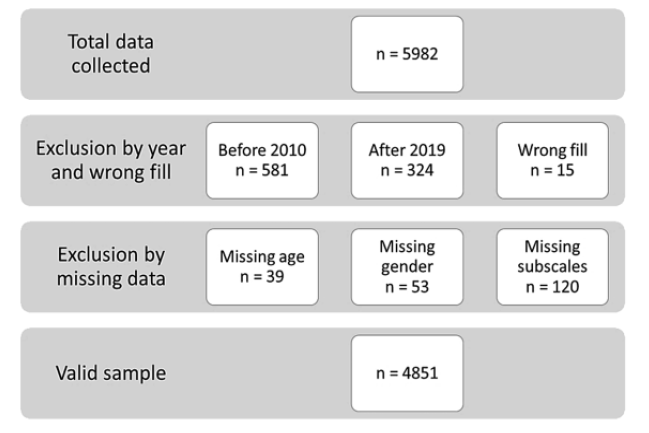
All databases provided by the collaborating researchers were organized and standardized to facilitate data access and subsequent analyses, considering instrument outputs (syndromes/groupings). As each dataset originated from a different city or region, no duplicate cases were expected given the independent origin of the datasets. Nevertheless, participants’ dates of birth were verified, and in cases where two or more individuals shared the same date of birth, additional information –such as sex, education level, or other demographic variables, as well as the original study– was checked to confirm uniqueness. Data were excluded if collected before 2010 or after 2019, if improperly completed, or if containing missing information (Figure 1). Only data from studies conducted in Brazil with Brazilian adult participants (aged 18 to 59 years) were included.
Participants were categorized into two age groups, comprising the youngest (18 to 35 years) and middle-aged (35 to 59 years) according to the questionnaire manual (Achenbach & Rescorla, 2003). The results were categorized according to the need or not for clinical intervention (categorical variable, «non-clinical», «borderline» and «clinical», the last two having been grouped in the survey as «borderline/ clinical»).
Figure 1
Process of data validation
Data analysis
Descriptive statistics were performed for the variables sex (male and female) and age range (18 to 35 years and 36 to 59 years). Multiple Correspondence Analysis (MCA) was used to draw the profiles of adults with indications of clinical intervention. Frequencies were considered for borderline/clinical range on the ASR scales and subscales, sex and age range. SPSS 25.0 software was used for the analyses.
Results
The research reached 5,982 protocols of adult assessments using ASR, of which 4,851 were included in the final sample. Sample characteristics according to sex, age group, state of origin, and year of response are presented in Table 1. Results for the scales and subscales assessed by the ASR according to sex, age groups, and percentage in borderline/ clinical range are presented in Table 2.
Table 1
Sample characteristics (age, state of origin and year of response) according to sex
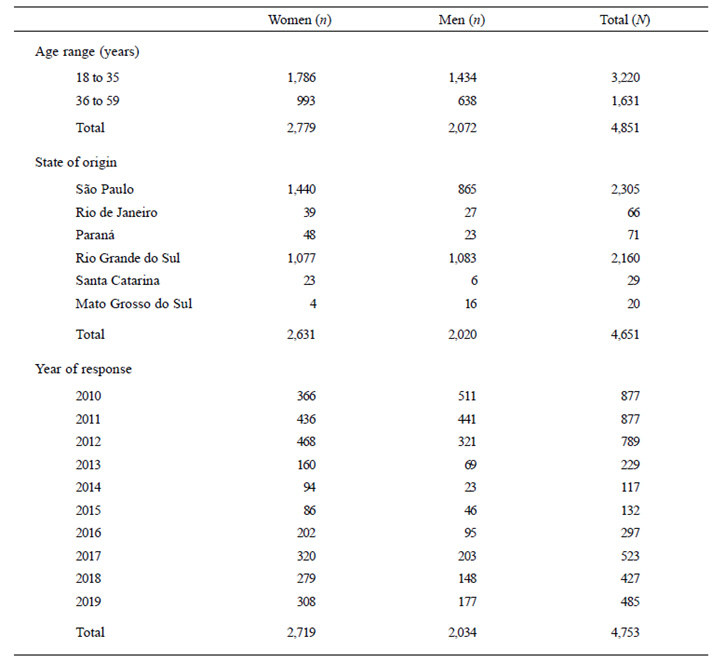
Note. N = total sample; n = subgroup size. Values represent frequencies. Totals may differ across sections due to missing data in some variables.
Table 2
Results of the ASR scales and subscales (mean, standard deviation and percentage of borderline/clinical participants) according to sex and age groups
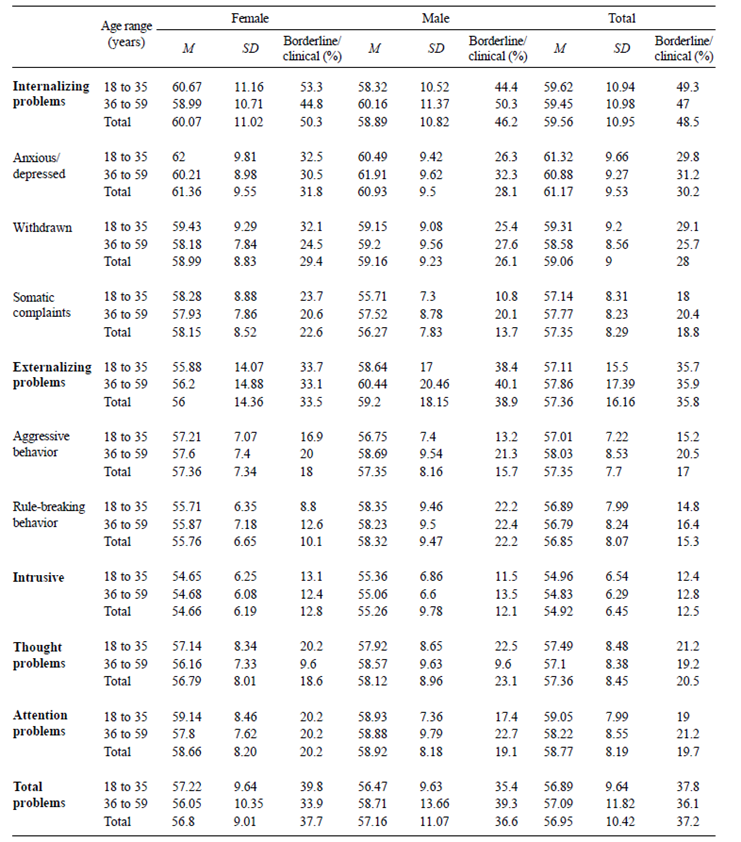
In most scales and subscales, mean scores were below the clinical cutoff (Table 2), with the exception of the Internalizing scale, in which the mean scores of young women and middle-aged men fell within the clinical/borderline range. In all other scales and groupings, mean scores remained below the cutoff for both men and women, regardless of age group. It is noteworthy, as shown in Table 2, that men presented a slightly higher mean score on the Withdrawn subscale (male = 59.16 vs. female = 58.99), despite a lower percentage of male individuals classified as clinical/borderline (male = 26.1% vs. female = 29.4%).
To draw the problem profile of the adults assessed, MCA was performed. The inertia of the two dimensions explained 73.9% of the data. By observing the distribution of the ASR scales and subscales (Figure 2), it can be said that women had clinical-level scores on more subscales than men, including both Internalizing and Externalizing Problems. Men had a greater association with clinical levels of rule-breaking behavior and thinking problems. Younger adults were associated with Thought Problems, Withdrawn, Intrusive and Anxiety/ Depression. Middle-aged people had a greater association with Attention Problems, Somatic Complaints and Aggressive Behavior. Also, by observing Figure 2, it can be stated that men and women, and younger and middle-aged adults, present their own symptomatology, with few similarities between the profiles.
Figure 2
Problem profile in clinical levels of the adults evaluated
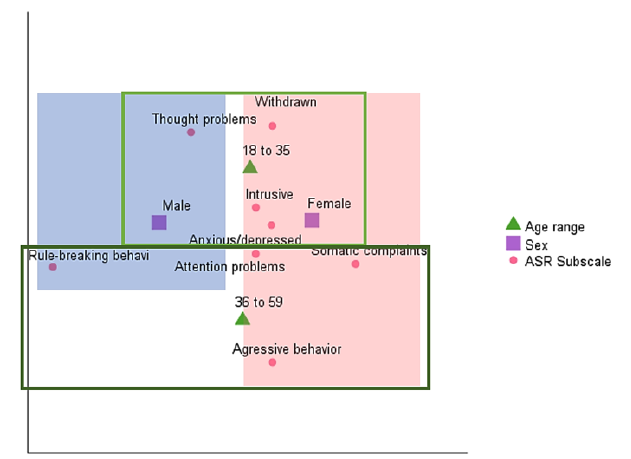
Note. shaded pink = women’s profile; shaded blue = men’s profile; light green square = younger adults’ profile; dark green square = older adults’ profile.
Three profiles were identified through Multiple Correspondence Analysis (MCA): Profile 1 (upper right) comprised young adults, female, associated with the Internalizing Problems Scale and the groupings of Anxious/Depressed, Withdrawn, and Intrusive; Profile 2 (lower region) comprised middle-aged adults, associated with the Externalizing Problems Scale and the groupings of Aggressive Behavior and Attention Problems; and Profile 3 (left side) comprised males, associated with the groupings of Rule-Breaking Behavior and Attention Problems.
Discussion
Seeking to draw profiles of internalizing and externalizing problems in Brazilian adults, this study presented results from 2010 to 2019 from a sample of 4,851 Brazilian adults, from the Southeast, Middle- West and South regions of the country, assessed using the ASR, ASEBA’s self-report instrument. The results indicate that Internalizing Problems were in the borderline/clinical range in 48.5% of the sample, comprising 46.2% of men and 50.3% of women (Table 2). This more comparable distribution between men and women for Internalizing Problems (which include Anxiety/Depression, Withdrawn, and Somatic Complaints) differs from the broader trend reported in Brazilian top-down studies, in which women show higher prevalence rates of anxiety and depression (e.g., Andrade, Viana, & Silveira, 2006; Andrade et al., 2012; Munhoz et al., 2016; Bonadiman et al., 2017). In the present study, although employing a bottom-up methodological approach, similar results were observed, with women presenting higher mean scores in the Anxiety/Depression and Somatic Complaints groupings, as well as in the Internalizing Problems scale, compared to men. The first hypothesis of this study was confirmed. Women tend to exhibit a higher prevalence of internalizing behaviors than men, possibly due to the interaction of biological factors (including hormonal influences), sex socialization processes/structural factors, and differences in the expression and management of psychological distress. In this sense, there is growing evidence regarding how biological/hereditary and psychosocial/cultural factors shape mental suffering (Kayrouz et al., 2025; Molina et al., 2024; Phillips et al., 2023; Rescorla et al., 2016).
Similarly to the findings of Shahini et al. (2023), the present study identified higher mean scores for Internalizing Problems than for Externalizing Problems in both sexes, with a higher percentage of men classified as clinical on the Externalizing scale and in the Rule-Breaking grouping. Oliveira-Monteiro et al. (2015) also using the ASR, investigated Externalizing Problems in 239 adults from the Metropolitan Region of Baixada Santista (in the state of São Paulo - Brazil), from different economic classes and educational levels. The mean scores for Externalizing Problems were within the non-clinical range –as observed in the present study– overall, with no differences between males and females in the sample. Thereby hypothesis «b» of this study is confirmed. However, it is noteworthy that a greater proportion of women fell within the clinical/borderline range in the Aggressive Behavior subscale.
In the present research, Externalizing Problems were in the borderline/clinical range for less than a third of the total sample, at a percentage of nearly 30% in both men and women. All externalizing syndrome scales (Aggressive Behavior, Rule- Breaking Behavior, and Intrusive) showed lower percentages than internalizing syndrome scales (Anxiety/Depression, Withdrawn, and Somatic Complaints). These data are corroborated by the results of De Ávila et al. (2019), who showed that Externalizing Problems are reported less by the person themselves than by those who live with them. In this study, although the mean scores were below the cutoff point, as expected in a population-based study, problematic behaviors were reported as present within the six months preceding completion of the instrument. This indicates the presence of psychological distress and underscores the need for further investigation and greater public investment in mental health. This concern is supported by the proportion of individuals whose scores fell within the clinical/borderline range.
The data analyzed in this research refers to the years 2010 to 2019. It would be interesting to compare, in the future, data from the present study with effects of social isolation and lockdown measures on subjects’ mental health are likely to happen and are still being evaluated. One study worth mentioning is that of Andersen et al. (2021), French research that assessed symptoms of anxiety and depression before and during the COVID-19 pandemic from data from the Trajectoires ÉpidéMiologiques en Population (TEMPO). A total of 662 subjects participated in the survey, with the ASR Anxiety/Depression subscale as the assessment instrument. As results, the authors noted that those who already had symptoms of anxiety and depression before the pandemic were almost seven times more likely to have these symptoms during the French lockdown (March to June 2020). Social isolation, as a measure to contain Covid-19, led to a prevalence of symptoms of anxiety and depression in adults, however, sociodemographic variables influenced the manifestation of these symptoms (Prieto et al., 2020).
The ways in which internalizing and externalizing problems vary across age and sex remain an important topic for further investigation, particularly considering the developmental trajectories of problematic behavioral patterns across the lifespan (van Loo et al., 2023). In the present study, older women showed lower mean scores for internalizing problems compared to younger women, a finding consistent with studies based on internalizing diagnoses such as anxiety and depression (Farhane- Medina et al., 2024; Kundakovic & Rocks, 2022; Molina et al., 2024). In contrast, older men presented higher scores compared to younger men. Developmental and social differences in prevalence among men and women, particularly around the age of menopause, warrant further investigation. Multiple factors influence mental health, as well as the clinical manifestation of behavioral problems. Taken together, these findings suggest important differences in the mental health of men and women, as also highlighted by Kayrouz et al. (2025).
Regarding age group, it was observed that, in some scales/groupings, a higher percentage of young adults fell within the clinical/borderline range, whereas in others this was more frequent among middle-aged individuals (Table 2). MCA further highlighted associations by age group (Figure 2), indicating that young adults presented more internalizing problems, while middle-aged adults showed more externalizing problems. It is noteworthy that young women exhibited higher mean scores across nearly all scales/subscales compared to middle-aged women, underscoring the substantial impact of factors influencing mental health among younger individuals, who are experiencing significant social and professional transitions. Other studies have similarly reported higher levels of psychological distress among younger populations compared to older generations (Ipsos, 2024; Molina et al., 2022).
Recent research indicates that young adults show a higher prevalence of mental health problems than middle-aged adults, a phenomenon associated with developmental and contextual factors characteristic of this stage of the life cycle. Young adulthood is marked by entry into the labor market, identity consolidation, and the establishment of affective and professional relationships–factors that may increase exposure to psychological stressors. In addition, many mental disorders have their onset during adolescence or early adulthood, contributing to a higher concentration of symptoms in this age group. Recent epidemiological data show that young adults report higher levels of psychological distress and mental disorders compared to older age groups (GBD 2019 Mental Disorders Collaborators, 2022; O’Dowd, 2025; Schoen et al., 2025; WHO, 2026).
The results of the MCA (Figure 2) revealed a differentiated pattern of association between sex, age group, and types of reported psychological problems. Women, particularly those aged 18 to 35 years, formed a profile in which Internalizing Problems were more prevalent such as Anxiety/Depression, Withdrawn, and Somatic Complaints. In contrast, men formed a profile more closely associated with Externalizing Problems, such as Rule-Breaking Behavior and Attention Problems. Furthermore, individuals aged 36 to 59 years demonstrated an Externalizing Behaviors profile, particularly Aggressive Behavior. Taken together, these findings suggest that both sex and age are associated with distinct profiles of psychological problems, highlighting a pattern of greater predominance of internalizing symptoms among young women and externalizing behaviors among men and middle-aged adults.
Conclusions
With the MCA, it was possible to visualize symptomatology profiles of the Brazilian adults evaluated and to understand how their psychological difficulties are configured, which seems to be different from other studies in different cultures (with the due limitation of comparisons, since other studies did not use the MCA). Future research should focus on refining and reducing the attributes evaluated, which may further enhance the identification of symptom profiles.
It is important to emphasize that two different conceptions were observed in relation to psychopathology: the categorical or top-down and the dimensional or bottom-up. It is possible that the difference in results in relation to sex is due to the fact that the instrument used here is of the bottom- up type, analyzing behaviors. In practical terms, both men and women present internalizing behavior problems, that is, they present psychological distress, although previous Brazilian studies, being of the top- down type, identified more women with anxiety or depression. This means that prevention and intervention projects would be beneficial for both sexes, especially those under 35 years of age, since both women and men indicate items that indicate more difficult behaviors. Universal prevention projects that address how to face the challenges of the adult world (work, family, friendships, finances...) are necessary to minimize suffering.
As a limitation of the work, we point out the fact that the data come from different surveys, each with a different objective. Therefore, it is possible to have a greater number of protocols coming from participants in clinical studies involving, for example, the use of drugs or tobacco, or a greater number of university students than that existing in the Brazilian population. The researchers shared only data related to the instrument (age, sex, and scores), without providing additional information about participants from the original studies. It is important to note that each study used different methods to assess participants’ socioeconomic status (e.g., Critério Brasil, household income, educational level, place of residence), but this data were not shared. Another limitation of the research was the division by age group presented (18 to 35 years; 36 to 59 years). Here, the questionnaire manual was followed, and in accordance with other research that used the same reference in other studies with adults. We understand that this is an arbitrary division and does not correspond to the most recent definitions of adulthood, such as emerging adulthood and established adulthood. However, this limitation does not compromise the relevance of the findings, which contribute to expanding knowledge about adult mental health in Brazil.
This study, grounded in the principles of open science, assessed mental health in the general Brazilian population using an internationally recognized instrument, thereby facilitating comparability of the findings. As this was a cross- sectional study, it was not possible to establish causal relationships between the variables. It should also be noted that participants’ socioeconomic status –an important factor that may influence the results– was not assessed.
Finally, it is hoped that the limitations present in this research can be combined with the advances made in its contribution to mental health assessment of our adult population.
Conflicts of interest
On behalf of all authors, the corresponding author states that there is no conflict of interest.
Ethical responsibility
The project was submitted through Plataforma Brasil to the evaluation of the Research Ethics Committee of Unifesp, and was approved (Opinion number: 3.831.330). The study follows ethical rules for research with human subjects. Those responsible for the original databases are not identified.
Authorship contributions
NROM: investigation, methodology, project administration, resources, supervision, writing (review and editing).
THS: data curation, investigation, methodology, resources, writing (review and editing)
MRF: investigation, resources, writing (review and editing).
MFRA: conceptualization, data, curation, formal analysis, methodology, writing (original draft, review and editing).
References
Abril-Valdez, E., Román-Pérez, R., Cubillas, M. J., & Domínguez, S. E. (2024). Consumo de drogas en mujeres del Noroeste de México. Liberabit, 30(2), e831.
Achenbach, T. (2024). Achenbach System of Empirically Based Assessment (ASEBA): Catalog 2024. ASEBA. https://aseba.org/wp-content/uploads/2024-Catalog.pdf
Achenbach, T. M. (2010). Mental health practitioners’ guide for the achenbach system of empirically based assessment (ASEBA): An integrated system of multi- informant (9th ed.). University of Vermont.
Achenbach, T. M., & Rescorla, L. A. (2003). Manual for the ASEBA adult forms & profiles for ages 18-59: adult self-report and adult behavior checklist. ASEBA, University of Vermont.
Achenbach, T. M., Ivanova, M. Y., & Rescorla, L. A. (2017). Empirically based assessment and taxonomy of psychopathology for ages 1½–90+ years: Developmental, multi-informant, and multicultural findings. Comprehensive Psychiatry, 79, 4-18. https://doi.org/10.1016/j.comppsych.2017.03.006
Achenbach, T. M., Ivanova, M. Y., Rescorla, L. A., Turner, L. V., & Althoff, R. R. (2016). Internalizing/externalizing problems: Review and recommendations for clinical and research applications. Journal of the American Academy of Child and Adolescent Psychiatry, 55(8), 647-656. https://doi.org/10.1016/j.jaac.2016.05.012
Alvarado-Zurita, P., & Rodas, J. A. (2024). Estrategias de regulación emocional cognitiva: diferencias de género en Ecuador. Liberabit, 30(1), e727.
American Psychiatric Association. (2023). Diagnostic and statistical manual of mental disorders - DSM-5 TR (5th ed.). Editorial Médica Panamericana.
Andersen, A. J., Mary-Krause, M., Bustamante, J. J. H., Héron, M., El Aarbaoui, T., & Melchior, M. (2021). Symptoms of anxiety/depression during the COVID-19 pandemic and associated lockdown in the community: Longitudinal data from the TEMPO cohort in France. BMC Psychiatry, 21(1), 381. https://doi.org/10.1186/s12888-021-03383-z
Andrade, L. H. S. G. de, Viana, M. C., & Silveira, C. M. (2006). Epidemiologia dos transtornos psiquiátricos na mulher. Archives of Clinical Psychiatry, 33(2), 43-54. https://doi.org/10.1590/s0101-60832006000200003
Andrade, L. H., Wang, Y.-P., Andreoni, S., Silveira, C. M., Alexandrino-Silva, C., Siu, E. R., Nishimura, R., Anthony, J. C., Gattaz, W. F., Kessler, R. C., & Viana, M. C. (2012). Mental disorders in megacities: Findings from the São Paulo megacity mental health survey, Brazil. PLoS ONE, 7(2), e31879. https://doi.org/10.1371/journal.pone.0031879
De Ávila, A. C., Pante, M., Yates, M. B., da Silva, D. C., Schütz, D. M., & Oliveira, M. S. (2019). Associação entre autoavaliação e a análise de informantes sobre sintomas psicopatológicos em uma amostra adulta. Contextos Clínicos, 12(3), 902-920. https://doi.org/10.4013/ctc.2019.123.10
Bianchi, V., Rescorla, L., Rosi, E., Grazioli, S., Mauri, M., Frigerio, A., Achenbach, T. M., Ivanova, M. Y., Csemy, L., Decoster, J., Fontaine, F. R. J., Funabiki, Y., Ndetei, D. M., Oh, K. J., Rocha, M. M., Simulioniene, R., Sokoli, E., Monteni, M., & Nobile, M. (2022). Emotional dysregulation in adults from 10 world societies: An epidemiological latent class analysis of the Adult-Self- Report. International Journal of Clinical and Health Psychology, 22(2), 100301. https://doi.org/10.1016/j.ijchp.2022.100301
Bonadiman, C. S. C., Passos, V. M. de A., Mooney, M., Naghavi, M., & Melo, A. P. S. (2017). A carga dos transtornos mentais e decorrentes do uso de substâncias psicoativas no Brasil: Estudo de Carga Global de Doença, 1990 e 2015. Revista Brasileira de Epidemiologia, 20(Suppl. 1), 191-204. https://doi.org/10.1590/1980-5497201700050016
Brito, V. C. A., Bello Corassa, R., Stopa, S. R., Sardinha, L. M. V., Dahl, C. M., & Viana, M. C. (2022). Prevalência de depressão autorreferida no Brasil: Pesquisa Nacional de Saúde 2019 e 2013. Epidemiologia e Serviços de Saúde, 31(Suppl. 1), e2021384. https://doi.org/10.1590/SS2237-9622202200006.especial
Carvalho, P. L., Araújo, F. R., Martins, F. R., Scachetti, R. E., & Oliveira-Monteiro, N. R. (2024). Internalizing and externalizing problems in students. Estudos Interdisciplinares em Saúde, 13(1), e2426. https://doi.org/10.33362/ries.v13i1.2426
Copeland, W. E., Ivanova, M. Y., Achenbach, T. M., Turner, L. V., Tong, G., Ahmeti-Pronaj, A., Au, A., Bellina, M., Caldas, J. C., Chen, Y. C., Csemy, L., da Rocha, M. M., Dobrean, A., Ezpeleta, L., Funabiki, Y., Harder, V. S., Lecannelier, F., Leiner, M., Leung, P., … Zasepa, E. (2023). Cultural contributions to adults’ self-rated mental health problems and strengths: 7 culture clusters, 28 societies, 16,906 adults. Psychological Medicine, 53(16), 7581-7590. https://doi.org/10.1017/S0033291723001332
Farhane-Medina, N. Z., Luque, B., Tabernero, C., & Castillo-Mayén, R. (2022). Factors associated with gender and sex differences in anxiety prevalence and comorbidity: A systematic review. Science Progress, 105(4). https://doi.org/10.1177/00368504221135469
GBD 2017 Disease and Injury Incidence and Prevalence Collaborators. (2018). Global, regional, and national incidence, prevalence, and years lived with disability for 354 diseases and injuries for 195 countries and territories, 1990-2017: A systematic analysis for the Global Burden of Disease Study 2017. The Lancet, 392(10159), 1789-1858. https://doi.org/10.1016/S0140-6736(18)32279-7
GBD 2019 Diseases and Injuries Collaborators. (2020). Global burden of 369 diseases and injuries in 204 countries and territories, 1990-2019: A systematic analysis for the Global Burden of Disease Study 2019. The Lancet, 396(10258), 1204-1222. https://doi.org/10.1016/S0140-6736(20)30925-9
GBD 2019 Mental Disorders Collaborators. (2022). Global, regional, and national burden of 12 mental disorders in 204 countries and territories, 1990-2019: A systematic analysis for the Global Burden of Disease Study 2019. The Lancet Psychiatry, 9(2), 137-150. https://doi.org/10.1016/S2215-0366(21)00395-3
Gimeniz-Paschoal, S. R., Schoen, T. H., Marteleto, M. R. F., & Sapienza, G. (2022). Saúde mental, psicopatologia e ciclo de vida: Uma perspectiva dimensional. CRV.
Hexsel, G., Scarabelot, K., Claumann, G., & Pelegrini, A. (2023). Sintomas depressivos em estudantes universitários: Prevalência e fatores associados. Psicologia, Saúde & Doenças, 24(3), 894-906. https://doi.org/10.15309/23psd240309
Hyde, J. S., & Mezulis, A. H. (2020). Gender differences in depression: Biological, affective, cognitive, and sociocultural factors. Harvard Review of Psychiatry, 28(1), 4-13. https://doi.org/10.1097/HRP.0000000000000230
Ipsos. (2024). Ipsos Health Service Report 2024: Mental health seen as the biggest health issue. https://www.ipsos.com/en/ipsos-health-service-report-2024-mental-health-seen-biggest-health-issue
Ivanova, M. Y., Achenbach, T. M., Rescorla, L. A., Turner, L. V., Árnadóttir, H. A., Au, A., Caldas, J. C., Chaalal, N., Chen, Y. C., da Rocha, M. M., Decoster, J., Fontaine, J. R. J., Funabiki, Y., Gudmundsson, H. S., Kim, Y. A., Leung, P., Liu, J., Malykh, S., Markovic, J., … Zasepa, E. (2015). Syndromes of collateral-reported psychopathology for ages 18-59 in 18 societies. International Journal of Clinical and Health Psychology, 15(1), 18-28. https://doi.org/10.1016/j.ijchp.2014.07.001
Kayrouz, R., Karin, E., Staples, L., Dear, B., Nielssen, O., & Titov, N. (2025). A review of the 257 meta-analyses of the differences between females and males in prevalence and risk, protective factors, and treatment outcomes for mental disorder. BMC Psychiatry, 25(1), 677. https://doi.org/10.1186/s12888-025-06848-7
Krueger, R. F., Hobbs, K. A., Conway, C. C., Dick, D. M., Dretsch, M. N., Eaton, N. R., Forbes, M. K., Forbush, K. T., Keyes, K. M., Latzman, R. D., Michelini, G.,Patrick, C. J., Sellbom, M., Slade, T., South, S. C., Sunderland, M., Tackett, J., Waldman, I., Waszczuk, M. A., & Zinbarg, R. E. (2021). Validity and utility of hierarchical taxonomy of psychopathology (HiTOP): II. Externalizing superspectrum. World Psychiatry, 20(2), 171-193. https://doi.org/10.1002/wps.20844
Kundakovic, M., & Rocks, D. (2022). Sex hormone fluctuation and increased female risk for depression and anxiety disorders: From clinical evidence to molecular mechanisms. Frontiers in Neuroendocrinology, 66, 101010. https://doi.org/10.1016/j.yfrne.2022.101010
Liu, J., Dong, F., Lee, C. M., Reyes, J., & Ivanova, M. (2021). The application of the adult self-report and the adult behavior checklist form to Chinese adults: Syndrome structure, inter-informant agreement, and cultural comparison. International Journal of Environmental Research and Public Health, 18(12), 6352. https://doi.org/10.3390/ijerph18126352
Lucena-Santos, P., Moraes, J. F. D., & Oliveira, M. S. (2015). Análise da estrutura fatorial das escalas sindrômicas do ASR (Adult Self-Report). Interamerican Journal of Psychology, 48(3), 237-249.
Machado, M. S., & Silva, M. M. (2024). Prevalência de sintomas depressivos entre adultos jovens no Brasil: resultados das edições de 2013 e 2019. Revista Brasileira de Epidemiologia, 27, e240045. https://doi.org/10.1590/1980-5497-20242700045
Melo, A. P. S., Bonadiman, C. S. C., de Andrade, F. M., Pinheiro, P. C., & Malta, D. C. (2023). Depression screening in a population-based study: Brazilian National Health Survey 2019. Ciência e Saúde Coletiva, 28(4), 1163-1174. https://doi.org/10.1590/1413-81232023284.14912022
Molina, N. P. F. M., Pereira Junior, A. C., Di Donato, G., Rezende, M. A. D., Zanetti, M. O. B., Haas, V. J., & Miasso, A. I. (2024). Common mental disorders in Brazilian graduate students. Mental Illness, 2024, 6986548. https://doi.org/10.1155/2024/6986548
Munhoz, T. N., Nunes, B. P., Wehrmeister, F. C., Santos, I. S., & Matijasevich, A. (2016). A nationwide population- based study of depression in Brazil. Journal of Affective Disorders, 192, 226-233. https://doi.org/10.1016/j.jad.2015.12.038
Nardi, A. E., Silva, A. G., & Quevedo, J. (2022). Tratado de psiquiatria da Associação Brasileira de Psiquiatria. Artmed.
O’Dowd, A. (2025). Quarter of young adults in England have a mental health condition, data suggest. BMJ, 389, r1351. https://doi.org/10.1136/bmj.r1351
Oliveira-Monteiro, N. R., Scachetti, R. E., Frabetti, S., & Aznar-Farias, M. (2015). Problemas externalizantes e pró-socialidade em adultos. Aletheia, 47-48, 155-168.
Parola, A., & Iodice D’Enza, A. (2021). Analysis of young people not engaged in education, employment or training: A fuzzy MCA-based approach. Statistica Applicata – Italian Journal of Applied Statistics, 33(1), 65-82.
Phillips, S. P., O’Connor, M., & Vafaei, A. (2023). Women suffer but men die: Survey data exploring whether this self-reported health paradox is real or an artefact of gender stereotypes. BMC Public Health, 23(94). https://doi.org/10.1186/s12889-023-15011-4
Prieto, D. E, Aguirre, G. L., de Pierola, I., Luna, G., Merea, L. A, Lazarte, C. S., Uribe, K. A., & Zegarra, A. C. (2020). Depresión y ansiedad durante el aislamiento obligatorio por el COVID-19 en Lima Metropolitana. Liberabit, 26(2), e425. https://doi.org/10.24265/liberabit.2020.v26n2.09
Rescorla, L. A., Achenbach, T. M., Ivanova, M. Y., Turner, L. V., Árnadóttir, H., Au, A., Caldas, J. C., Chen, Y. C., Decoster, J., Fontaine, J., Funabiki, Y., Guðmundsson, H. S., Leung, P., Liu, J., Maraš, J. S., Markovic, J., Oh, K. J., da Rocha, M. M., Samaniego, V. C., … Zasepa, E. (2016). Collateral reports and cross-informant agreement about adult psychopathology in 14 societies. Journal of Psychopathology and Behavioral Assessment, 38(3), 381-397. https://doi.org/10.1007/s10862-016-9541-2
Rocha, M. M., Gauy, F. V., & Silvares, E. F. M. (2012). Uma comparação da autoavaliação do adulto/cliente com a do seu terapeuta. In Resumos de Comunicações Científicas Apresentadas na 42a Reunião Anual Da Sociedade Brasileira de Psicologia e VIII Congresso Iberoamericano de Psicologia. Sociedade Brasileira de Psicologia, São Paulo, Brasil.
Schoen, T. H., Marteleto, M. R. F., Sapienza, G., Gimeniz- Paschoal, S. R., Fernandes, L. F. B., Araújo, F. R., Campinas, M. T., Marin, A. H., & Ivanova, M. Y. (2025). Prevalence of internalizing and externalizing problems in different stages of life and regions of Brazil. Psico, 56(1), e47163. https://doi.org/10.15448/1980-8623.2025.1.47163
Schoen, T. H., Oliveira-Monteiro, N. R., Silva, J. A., & Marteleto, M. R. (2022). Dimensão internalizante e dimensão externalizante: Taxonomia hierárquica. In S. R. Gimeniz-Paschoal, T. H. Schoen, M. R. Marteleto, & G. Sapienza (Eds.), Saúde Mental, Psicopatologia e Ciclo de Vida: Uma Perspectiva Dimensional (pp. 43-66). CRV.
Shahini, M., Telaku, N., Sopjani, I., Kamberi, M., Fetahu, D., & Murtezaj, D. (2023). Emotional intelligence as a protective factor against mental health problems of health workers. Population Medicine, 5(32). https://doi.org/10.18332/popmed/176215
Statista. (2024). Prevalence of mental disorders in Brazil as of 2021, by selected category (per 100,000 people). Statista GmbH. https://www.statista.com/statistics/1337966/prevalence-mental-health-conditions-brazil/
Ten Have, M., Tuithof, M., van Dorsselaer, S., Schouten, F., Luik, A. I., & de Graaf, R. (2023). Prevalence and trends of common mental disorders from 2007-2009 to 2019-2022: results from the Netherlands Mental Health Survey and Incidence Studies (NEMESIS), including comparison of prevalence rates before vs. during the COVID-19 pandemic. World Psychiatry, 22(2), 275-285. https://doi.org/10.1002/wps.21087
Tian, J., Yan, N., Hu, X., Tian, S., Wang, Y., Mackay, L. E., Luo, Y., Wang, Y., Wang, Y., Liu, Y., Shiferaw, B. D., Lan, H., Yan, W., Wang, Q., Gao, X., Zhang, C., Xu, H., & Wang, W. (2025). Global burden of mental disorders among adolescents and young adults, 1990-2021: A systematic analysis of the Global Burden of Disease Study 2021. General Psychiatry, 38(6), e102278. https://doi.org/10.1136/gpsych-2025-102278
van Loo, H. M., Beijers, L., Wieling, M., de Jong, T. R., Schoevers, R. A., & Kendler, K. S. (2023). Prevalence of internalizing disorders, symptoms, and traits across age using advanced nonlinear models. Psychological Medicine, 53(1), 78-87. https://doi.org/10.1017/S0033291721001148
Viana, M. C. (2017). Brazil: World leader in anxiety and depression rates. The Lancet Psychiatry, 4(11), 821-822.
Watson, D., Levin-Aspenson, H. F., Waszczuk, M. A., Conway, C. C., Dalgleish, T., Dretsch, M. N., Eaton, N. R., Forbes, M. K., Forbush, K. T., Hobbs, K. A., Michelini, G., Nelson, B. D., Sellbom, M., Slade, T., South, S. C., Sunderland, M., Waldman, I., Witthöft, M., Wright, A. G. C., Kotov, R., Krueger, R., & HiTOP Utility Workgroup. (2022). Validity and utility of Hierarchical Taxonomy of Psychopathology (HiTOP): III. Emotional dysfunction superspectrum. World Psychiatry, 21(1), 26-54. https://doi.org/10.1002/wps.20943
World Health Organization. (2017). Depression and other common mental disorders: Global health estimates. https://iris.who.int/handle/10665/254610
World Health Organization. (2022). International statistical classification of diseases and related health problems (ICD) (11th ed.). https://icd.who.int/dev11/l-m/en#/http://id.who.int/icd/entity/437815624
World Health Organization. (2026). Mental health: Key facts. https://www.who.int/news-room/fact-sheets/detail/mental-health
Nancy Ramacciotti Oliveira-Monteiro
Psychologist. Habilitated Professor (Livre-Docente), Universidade Federal de São Paulo.
Teresa Helena Schoen
Psychologist and Pedagogue, Educational Affairs Specialist.
Márcia Regina Fumagalli Marteleto
Psychologist, PhD.
Fernanda Ribeiro Araújo
Psychologist, PhD, Postdoctoral Researcher, Interdisciplinary Graduate Program in Marine Sciences
© Los autores. Este es un artículo Open Access publicado bajo la licencia Creative Commons Atribución 4.0 Internacional (CC-BY 4.0).